
Reliable transfers are the single most consequential logistics decision a tourist makes before arriving at any destination. 61% of frequent travelers rank ground transport reliability among their top three factors for overall trip satisfaction, placing it on par with flight punctuality and hotel quality. That statistic reframes the entire conversation: your transfer is not a footnote to your trip. It is the foundation. Whether you are flying into Barcelona, Monaco, or Berlin, the quality of your ground transport shapes every impression that follows. Understanding why tourist areas need reliable transfers means understanding what separates a smooth vacation from a stressful one.
Why reliable transfers define the tourist experience
Reliable transfers, in the context of tourism, refer to pre-booked, professionally operated ground transport services that guarantee punctuality, fixed pricing, and driver identification before the journey begins. This is distinct from hailing a cab at the curb or relying on public transit with unfamiliar schedules. The industry term for this category is "pre-arranged private transfers," and it covers everything from airport pickups to inter-city shuttles and resort connections.
The core benefit is the elimination of uncertainty. Pre-booked transfers provide fixed-price guarantees, preventing the 10 to 20% price volatility that local taxis and ride-hailing apps routinely produce during peak hours or bad weather. For a tourist arriving after a long-haul flight, that predictability is not a luxury. It is the difference between starting a vacation relaxed or starting it anxious.
Unreliable transfers also create downstream problems that tourists rarely anticipate. A late pickup at the airport means a missed hotel check-in window. A no-show transfer at a remote trailhead means a ruined day trip. Common transfer failures including late pickups, no-shows, and pricing opacity consistently generate the highest volume of guest complaints across hotel and resort properties. These are not edge cases. They are systemic failures in destinations that treat transport as an afterthought.
- Pre-booked transfers include driver identification before arrival, removing the anxiety of identifying your ride in a crowded terminal
- Fixed pricing eliminates surge costs during peak travel windows like holidays and cruise ship arrivals
- Scheduled pickups with real-time confirmation reduce the cognitive load of navigating an unfamiliar city
- Pre-arranged shuttles at remote attractions align with park hours and safety curfews, making otherwise inaccessible destinations reachable
Pro Tip: Before booking any transfer, confirm that the provider offers real-time flight tracking. If your flight is delayed, a quality operator adjusts your pickup automatically. You should never have to call ahead to explain a delay.
Private transfers vs. public transportation: which serves tourists better?
The comparison between private transfers and public transportation is not simply about comfort. It is about operational reliability in environments that were not designed with tourists in mind. A 2026 Mediterranean coastal study of 1,954 visitors found that manual navigation caused 30 to 50% operational friction in tourist transfers, with visitors expressing strong preference for private, pre-booked vehicles over local transit systems.
Public transportation in tourist zones presents a specific set of challenges. Schedules are built for residents, not visitors. Routes rarely connect airports directly to resort areas or historic centers. Luggage restrictions on buses and metro systems create practical barriers that travel blogs rarely mention. And when a tourist misses a connection due to a delayed train, there is no customer service number to call and no accountability.
| Feature | Private transfer | Public transportation |
|---|---|---|
| Schedule flexibility | Departs on your timeline | Fixed schedule, no exceptions |
| Luggage handling | Door-to-door with full luggage | Restricted or self-managed |
| Pricing transparency | Fixed rate confirmed at booking | Variable fares, zone surcharges |
| Driver accountability | Named, vetted, trackable | Anonymous, no direct contact |
| Peak capacity | Reserved seat guaranteed | Standing room or service cuts |
| Remote destination access | Direct to any address | Limited to fixed stops |
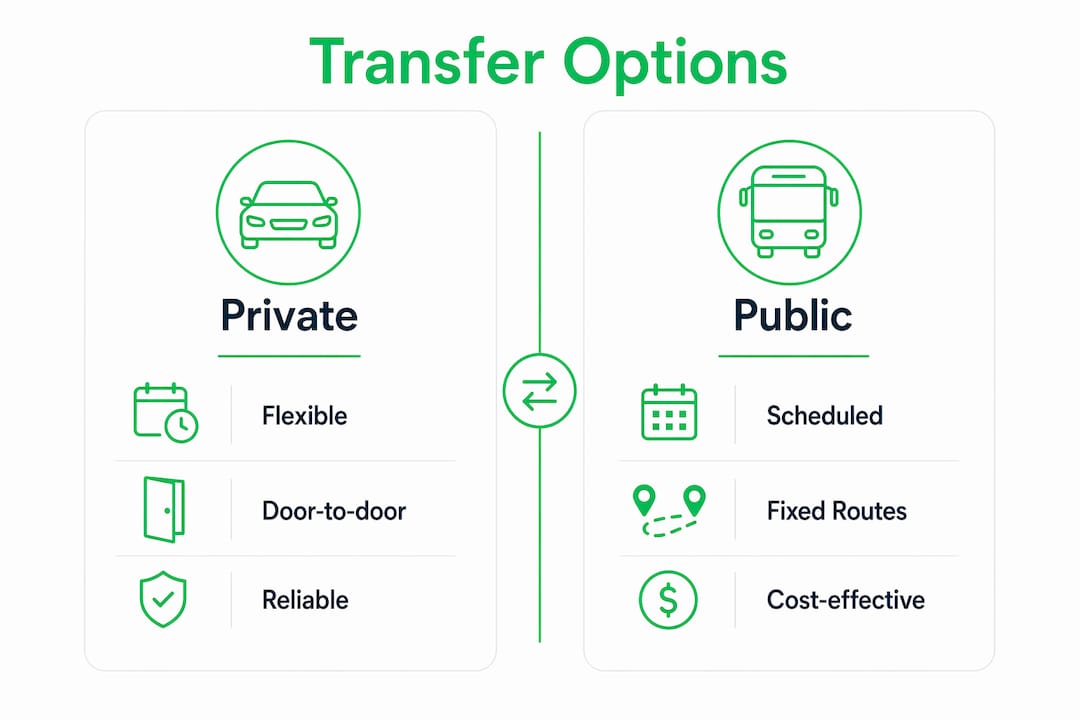
Cost is the most common objection to private transfers, and it deserves a direct answer. A private transfer from Nice Côte d'Azur Airport to a hotel in Cannes costs more than the regional train. But that comparison ignores the value of time, luggage logistics, and the cognitive cost of navigating an unfamiliar transit system after a transatlantic flight. For families, groups, or travelers with mobility considerations, the per-person cost of a private transfer often matches or beats public transit once you account for the full picture.
There is also the "parking zone trap" that most travelers never anticipate. At major airports, ride-hailing apps cannot access commercial pickup zones, forcing travelers to walk long distances with luggage to reach a designated pickup area. Licensed private transfer operators hold commercial permits that allow terminal-level access. That single operational detail can save 20 to 30 minutes on arrival.
How technology makes transfers more reliable
Digital systems have fundamentally changed what "reliable" means in the transfer industry. Transportation firms that implement real-time tracking and automated route optimization consistently outperform operators relying on manual scheduling, achieving higher punctuality rates and measurably better customer satisfaction scores.

The mechanics behind this improvement are straightforward. Automated dispatch assigns the nearest available driver the moment a booking is confirmed. Route optimization software accounts for live traffic, road closures, and event-related congestion. Passenger notification systems send updates at each stage of the journey, from driver assignment to estimated arrival. None of this is possible with a phone call to a local taxi company.
For tourists, the practical benefits of tech-enabled transfers include:
- Live GPS tracking of your driver before pickup, visible on a smartphone
- Automated flight monitoring that adjusts pickup times without passenger intervention
- Digital receipts and booking confirmations that satisfy corporate travel expense requirements
- In-app communication with drivers that bypasses language barriers through translation features
- Capacity management systems that scale operations during overlapping cruise or flight arrivals
That last point matters more than most travelers realize. Capacity elasticity is the ability of a transfer provider to scale up during peak loads, such as when three cruise ships dock simultaneously or a major festival ends. Operators without digital dispatch systems simply run out of available vehicles. Operators with integrated platforms reroute and reassign in real time.
Pro Tip: When evaluating transfer providers, ask specifically whether their booking platform integrates with flight data APIs. Providers that pull live flight status data directly into their dispatch system are structurally more reliable than those that rely on manual check-ins.
How reliable transfers shape a destination's economy
Transport infrastructure and tourism revenue are directly linked. Destinations investing in structured transport see measurably higher visitor satisfaction, longer average stays, and greater per-visit spending. The causal mechanism is not complicated: when tourists feel confident they can get around, they book more activities, venture further from their hotel, and return in future years.
The reverse is equally true. Travelers are deterred by uncertainty far more than by distance or terrain. A destination with stunning natural attractions but no reliable transfer options loses visitors not because the destination is unappealing, but because the logistics feel too unpredictable to commit to. Pre-bookable, digitally accessible transport removes that hesitation and directly increases destination appeal.
Tourism and transport networks function like the circulatory system of a region. The Tourism Institute's research frames coordinated transport strategy as non-negotiable for sustainable tourism development. Destinations that treat transfers as a peripheral concern, rather than a core infrastructure investment, consistently underperform on visitor retention metrics.
| Economic factor | Impact of reliable transfers |
|---|---|
| Visitor satisfaction scores | Higher ratings drive repeat visits and referrals |
| Average length of stay | Confident travelers book longer itineraries |
| Secondary spending | Accessible attractions generate more activity revenue |
| Destination competitiveness | Transfer quality influences booking decisions at the research stage |
For you as a traveler, this economic context has a practical implication. Destinations that have invested in private transport solutions for tourism agencies and operators tend to offer a noticeably smoother experience on the ground. The investment shows up in driver professionalism, vehicle quality, and the absence of the logistical chaos that plagues under-resourced tourist zones.
Key takeaways
Reliable transfers are the infrastructure layer that determines whether a tourist destination delivers on its promise or fails at the moment of arrival.
| Point | Details |
|---|---|
| Pre-booked transfers reduce anxiety | Fixed pricing and driver identification eliminate the uncertainty that causes travel stress. |
| Private transfers outperform public transit | For tourists, private options offer schedule flexibility, luggage handling, and terminal access that public systems cannot match. |
| Technology drives punctuality | Operators using real-time tracking and automated dispatch consistently outperform manual scheduling systems. |
| Transport quality drives economic outcomes | Destinations with reliable transfer infrastructure see longer stays, higher spending, and stronger visitor retention. |
| Capacity elasticity separates good from great | Providers that scale during peak loads protect tourists from the most common transfer failures. |
What I've learned about transfers that most travel advice gets wrong
I have spent years watching travelers obsess over flight deals and hotel reviews while treating the transfer as an afterthought they will figure out on arrival. That approach works fine until it doesn't. And when it fails, it fails at the worst possible moment: exhausted, jet-lagged, in an unfamiliar city, with luggage and a family in tow.
The conventional wisdom says to compare prices and read reviews. That is necessary but not sufficient. The question I now ask first is whether the provider has genuine capacity elasticity. Can they actually deliver when three other flights land at the same time? A company with 10 vehicles and great reviews is a different product from a company with 200 vehicles, digital dispatch, and flight tracking. The reviews might look identical. The operational reality is not.
I also think the industry undersells the value of named-driver confirmation. Knowing your driver's name, vehicle plate, and photo before you land is not a premium feature. It is a basic safety standard that every traveler should demand. The fact that many transfer providers still do not offer it in 2026 tells you something about how seriously they take the passenger experience.
The travelers who get this right treat the transfer booking the same way they treat the flight booking: early, deliberate, and with attention to the provider's operational infrastructure, not just their star rating. That shift in mindset consistently produces better outcomes, and it costs nothing extra to adopt.
— Arthur
Travel stress-free with Zont Cab
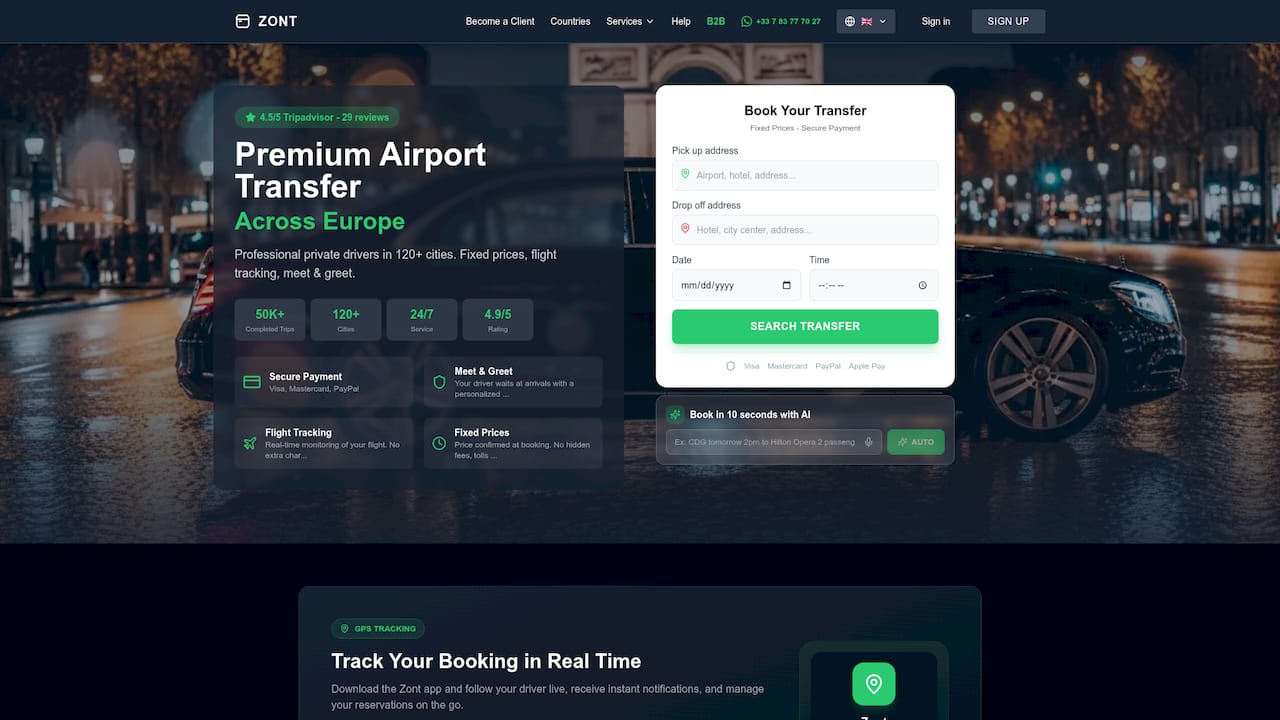
Zont Cab applies exactly the operational standards this article describes: flight tracking integrated directly into dispatch, named driver confirmation before every pickup, fixed pricing with no hidden fees, and premium vehicles across more than 120 European cities. With over 50,000 completed trips and a 4.5-star rating from verified TripAdvisor reviews, Zont Cab's track record reflects the reliability gap between professional transfer operators and improvised alternatives. Whether you are arriving at a Nice Côte d'Azur Airport transfer or need airport transfers across Europe, Zont Cab delivers the punctuality and professionalism that turns a stressful arrival into a smooth start. Book your transfer before you book your activities.
FAQ
Why do tourist areas need reliable transfers specifically?
Tourist areas attract visitors who are unfamiliar with local transport systems and have fixed itineraries. Unreliable transfers cause missed connections, wasted time, and negative first impressions that directly damage a destination's reputation and repeat visitor rates.
What makes a transfer service genuinely reliable?
A reliable transfer service combines fixed pricing confirmed at booking, named driver identification, real-time flight tracking, and the operational capacity to handle peak demand. Providers lacking digital dispatch systems are structurally unable to deliver consistent punctuality.
Are private transfers worth the cost over public transportation?
For most tourists, yes. Private transfers offer door-to-door service, luggage handling, and schedule flexibility that public transit cannot match. For groups or families, the per-person cost difference is often minimal once transit connections and time costs are factored in.
How does transport quality affect a destination's tourism economy?
Destinations with structured, reliable transport infrastructure see higher visitor satisfaction, longer stays, and greater per-visit spending. Poor transfer quality deters visitors at the research stage, before they ever book a flight.
What technology features should I look for in a transfer provider?
Prioritize providers with live GPS driver tracking, automated flight monitoring, and digital booking confirmation. These features indicate an operator running integrated dispatch systems rather than manual coordination, which directly translates to better punctuality and fewer no-shows.