
European airport transfer networks are coordinated systems that link real-time flight monitoring, automated dispatch technology, and vetted local operators to move passengers reliably between airports and their destinations. Understanding how these networks function is not just useful for curious logistics enthusiasts. It directly shapes how you plan, book, and experience every airport journey across the continent. Whether you are flying into Berlin BER, Paris CDG, or Alicante, the same operational logic applies. The network behind your ride is far more sophisticated than a simple car booking.
How European airport transfer networks work: technology and automated dispatch
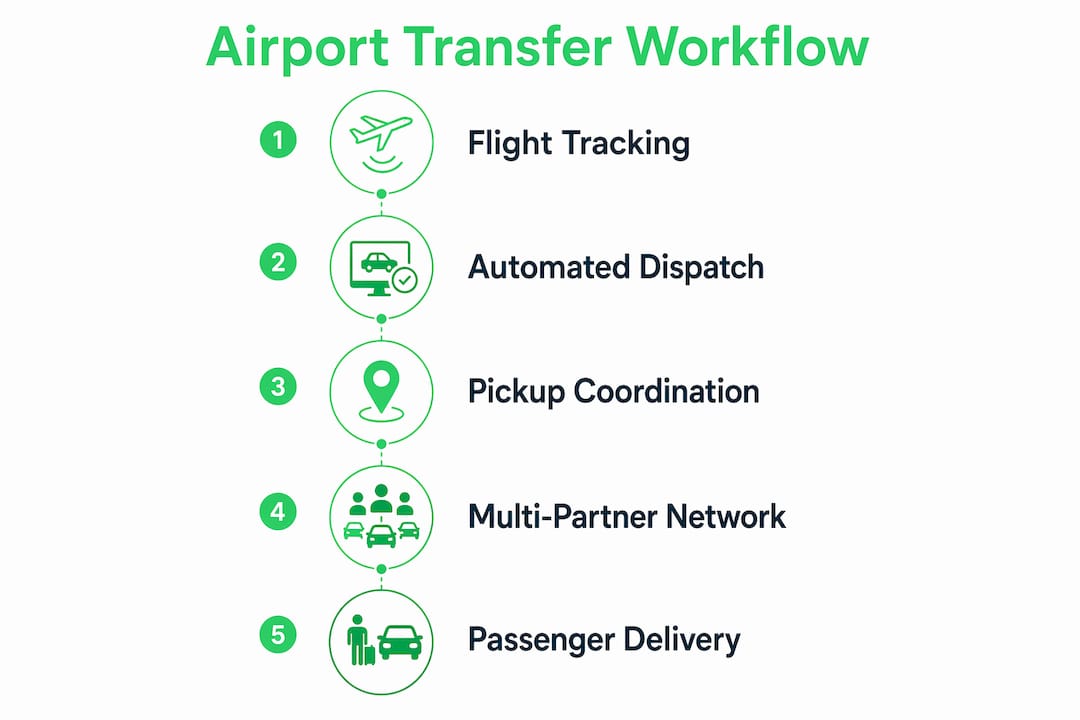
The operational backbone of any modern European airport transfer network is flight-number-based scheduling. When you book a transfer and provide your flight number, the system does not simply note your estimated arrival time. It monitors your flight in real time and adjusts your pickup automatically. Drivers receive automatic alerts for delays or early arrivals, recalculating pickup windows without any manual intervention. This is what separates a professional transfer network from a standard taxi booking.
The automation extends well beyond the driver's phone. Here is how a typical automated transfer workflow operates from booking to completion:
- Booking confirmation: The passenger receives an SMS and email confirmation immediately after booking, including driver details and a tracking link.
- Pre-trip reminder: An automated message goes out 24 hours before pickup, confirming the driver assignment and vehicle.
- Flight monitoring activation: The system begins tracking the flight number against live departure and arrival data.
- Dynamic pickup adjustment: If the flight is delayed by 40 minutes, the driver's dispatch time shifts accordingly. No phone call required.
- En-route tracking: Once the driver departs, the passenger receives a live GPS tracking link, so they know exactly when to walk to the pickup zone.
- Digital trip completion: The system logs the completed journey, triggers invoicing, and closes the booking automatically.
This level of automation allows transfer operators to manage hundreds of daily bookings without proportional increases in staff. Reliability in airport transfer networks arises primarily from coordination technology, not just vehicle quality. A luxury vehicle driven by an uncoordinated operator will still miss pickups. A well-dispatched standard vehicle will not.
Pro Tip: When booking airport transfers in Europe, always provide your flight number at checkout. Networks that use flight-number-based scheduling will adjust your pickup automatically if your flight changes, saving you the stress of calling ahead.
What role do airport pickup zones and restrictions play in transfer operations?
Airport pickup zones are not just logistical details. They are hard operational constraints that shape how every transfer network times and stages its vehicles. Large European airports enforce designated pickup and drop-off areas with strict rules, and the penalties for non-compliance are automatic and significant.
Manchester Airport is one of the clearest examples of how these rules work in practice:
- Pickups are restricted exclusively to the P3 zone across all three terminals.
- Drivers face a 15-minute maximum stay in the pickup zone before penalties apply.
- Unauthorized pickups outside designated zones trigger £100 fines via ANPR cameras that read license plates automatically.
- There is no grace period. The camera system does not distinguish between a driver who stopped for 30 seconds and one who waited 20 minutes.
That £100 fine is not just a financial hit. It represents a failure in timing coordination, which is why professional transfer networks treat curbside micro-timing as a core operational discipline. Drivers cannot simply park and wait. They pre-stage in permitted holding areas, monitor the passenger's progress through arrivals, and move to the pickup zone only when the timing is precise. Airport pickup success depends heavily on respecting these landside rules. The rules effectively design vehicle staging and timing for every operator working at that airport.
This constraint is not unique to Manchester. Amsterdam Schiphol, Frankfurt Airport, and London Heathrow all operate similar zone-based enforcement systems. Understanding airport transfers in Europe means understanding that the airport itself is an active participant in how your transfer is timed and executed.
How do multi-country partner networks enable door-to-door transfers across Europe?
No single transfer company owns a fleet in every European city. The geographic coverage that passengers experience when booking through a major platform is built on a network of vetted local operators, coordinated centrally. This is the structural reality behind most large-scale European airport transfer services.
| Feature | Shared shuttle services | Private transfer networks |
|---|---|---|
| Coverage model | Fixed routes, shared vehicles | Local partner fleets, point-to-point |
| Booking experience | Standardized, limited flexibility | Single booking, locally fulfilled |
| Supplier visibility | Operator usually visible | Local suppliers often hidden |
| Geographic reach | Hub airports only | 200+ countries, 950+ airports |
| Timing control | Fixed schedule | Dynamic, flight-tracked |

Door-to-door airport transfer services cover 200+ countries and 950+ airports by sourcing and coordinating vetted local partners. The passenger books once. The platform's dispatch center routes that booking to the appropriate local operator in the destination city, manages communication, and maintains quality standards. The passenger never needs to know which local company is actually providing the vehicle.
This model creates a genuinely broad network without requiring massive capital investment in owned fleets. The tradeoff is that quality depends entirely on how rigorously the platform vets and monitors its local partners. Platforms that invest in partner auditing, driver rating systems, and standardized vehicle requirements deliver consistent experiences. Those that treat local partners as interchangeable commodities do not.
Large airports also integrate concierge and ground transport services into this model. At airports like Paris CDG and Rome Fiumicino, transfer networks coordinate meet-and-greet services where a named driver holds a sign at arrivals, handles luggage, and escorts the passenger directly to the vehicle. This is not a luxury add-on. It is a coordination layer that reduces the chance of a missed connection in a complex terminal environment.
Pro Tip: When comparing platforms for booking airport transfers in Europe, ask specifically whether the platform uses its own drivers or local partners. If it uses partners, ask how those partners are vetted. The answer tells you everything about the consistency you can expect.
Comparing modes: airport shuttles versus private transfers and their network roles
European airport shuttle services and private transfers operate on fundamentally different network logics, and choosing between them affects both your experience and the operational complexity behind your ride.
Airport shuttles are shared, group services that run on fixed routes between airports and city centers or major hotels. They are cost-effective and work well when your schedule is flexible and your destination is on the route. The tradeoffs are real:
- Fixed departure times mean you wait for the shuttle, not the other way around.
- Multiple stops add 20 to 45 minutes to most journeys, depending on how many passengers are on board.
- No flight tracking integration is standard on most shuttle services. A delayed flight means you rebook manually.
- Luggage handling is shared space, not guaranteed.
Private transfers operate on a completely different model. The vehicle is assigned to you alone, the driver tracks your flight, and the route goes directly from the airport to your destination. The factors influencing airport transfer costs for private services include distance, vehicle class, time of day, and whether the booking includes meet-and-greet. Fixed pricing, which the best providers offer, eliminates the uncertainty of surge pricing or metered fares.
For business travelers, families with luggage, or anyone arriving at an unfamiliar airport late at night, private transfers are the operationally superior choice. For solo travelers on a budget heading to a well-served city center, a shuttle is a legitimate option. The best airport transfer options in Europe give you both choices within a single platform, letting you match the service type to the specific trip rather than defaulting to one mode for every journey.
Reliability is the decisive factor for most travelers. Automated flight tracking combined with GPS driver monitoring allows real-time pickup coordination that shuttle services structurally cannot replicate. When your flight lands 55 minutes late at 11 PM, a private transfer network adjusts automatically. A shuttle schedule does not.
Key takeaways
European airport transfer networks function through three interlocking systems: automated flight-tracking dispatch, airport zone compliance, and multi-country partner coordination.
| Point | Details |
|---|---|
| Flight-number scheduling | Always provide your flight number so the network adjusts your pickup automatically for delays or early arrivals. |
| Airport zone enforcement | Pickup zones at major hubs like Manchester Airport carry £100 fines and 15-minute limits, shaping how all drivers time arrivals. |
| Partner network structure | Platforms covering 950+ airports use vetted local operators, not owned fleets, to achieve broad geographic reach. |
| Private vs. shuttle trade-offs | Private transfers offer flight tracking and direct routing; shuttles offer lower cost but fixed schedules and multiple stops. |
| Coordination drives reliability | Technology coordination, not vehicle quality alone, determines whether a transfer network consistently delivers on time. |
What I've learned about the hidden mechanics of European airport transfers
I have spent years analyzing how ground transportation networks operate across Europe, and the insight that consistently surprises people is this: the most important variable in your transfer experience is not the car. It is the 90-second window when the driver has to be in exactly the right place at exactly the right time.
Most travelers think about airport transfers in terms of comfort and price. Logistics professionals think about them in terms of curbside micro-timing. At a hub like Heathrow or Frankfurt, a driver who arrives at the pickup zone two minutes too early faces a penalty. A driver who arrives two minutes too late finds the passenger already waiting in the wrong spot, confused, with no clear communication. Both failures look the same to the passenger: the transfer did not work.
What I find genuinely underappreciated is how much the airport's own infrastructure dictates the quality ceiling for every operator working there. A transfer company can have perfect technology and excellent drivers, but if the airport's pickup zone design forces a 400-meter walk from arrivals to the vehicle, the passenger experience degrades regardless. The best operators I have studied account for this by building terminal-specific pickup instructions into their confirmation messages, not just a generic "meet at arrivals."
The future of these networks is moving toward tighter integration between airline data feeds and ground transport dispatch. When a transfer platform can read not just flight status but also baggage carousel assignment and customs queue estimates, the pickup timing becomes genuinely precise. That capability exists in prototype form today. Within a few years, it will be standard for premium providers.
My practical advice: when you evaluate a transfer service, test their communication chain before you travel. Book a transfer, then check whether you receive a flight-tracking confirmation, a pre-trip reminder, and a live tracking link. If all three arrive without prompting, the network behind that service is built correctly.
— Arthur
Travel smarter across Europe with Zont
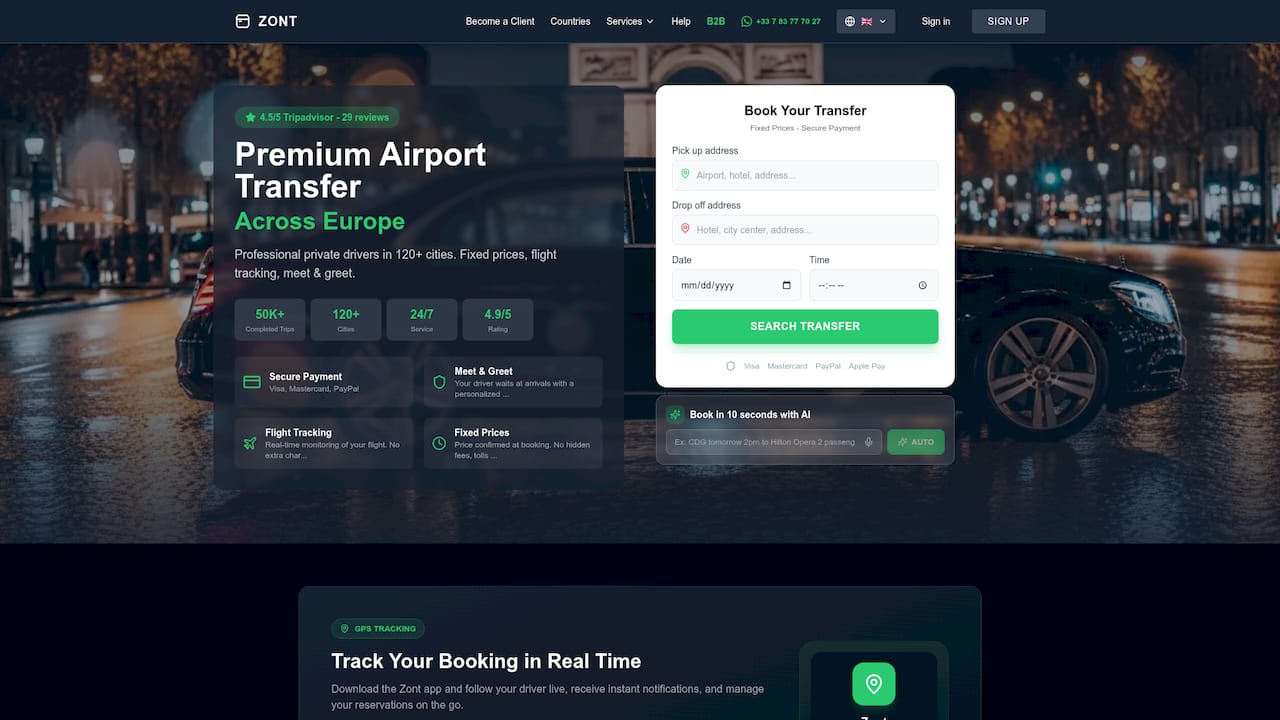
Zont operates premium airport transfers across 120+ European cities, applying exactly the network logic described in this article. Every booking includes real-time flight tracking, automated pickup adjustments, and a meet-and-greet driver who monitors your arrival before you clear customs. Fixed pricing means no surge fees, no hidden charges, and no surprises at the end of the ride. Zont's local partner network covers destinations from Berlin BER to Alicante Airport, with each partner held to consistent vehicle and service standards. With over 50,000 completed trips and a 4.5-star rating on TripAdvisor, Zont delivers the coordination technology and local expertise that make European airport transfers work the way they should.
FAQ
How does flight tracking work in airport transfer bookings?
Transfer platforms use your flight number to monitor live departure and arrival data, automatically adjusting your driver's dispatch time if the flight is delayed or lands early. Drivers receive automatic alerts and update their pickup timing without any manual communication from the passenger.
What are the pickup zone rules at major European airports?
Most large European airports designate specific pickup zones with strict time limits. Manchester Airport, for example, restricts pickups to the P3 zone with a 15-minute maximum stay and £100 fines for violations enforced by ANPR cameras.
How do airport transfer networks cover so many European destinations?
Coverage across hundreds of airports is achieved by coordinating vetted local operators rather than maintaining owned fleets everywhere. The passenger books once through a central platform, which routes the job to the appropriate local partner in each city.
When should I choose a private transfer over an airport shuttle?
Private transfers are the better choice when your flight may be delayed, you are traveling with significant luggage, or you need a direct route without stops. European airport shuttle services suit budget-conscious solo travelers heading to well-served city centers on a flexible schedule.
What factors influence the cost of airport transfers in Europe?
The main factors influencing airport transfer costs are distance from the airport, vehicle class, time of day, and whether meet-and-greet service is included. Fixed-price providers eliminate metered or surge pricing, making the total cost predictable at the time of booking.