
Airport transfer booking is the process of reserving a scheduled, fixed-price transportation service aligned with your flight details to and from the airport. Unlike hailing a cab at arrivals, a pre-booked transfer means a confirmed driver, a confirmed vehicle, and a price locked in before you ever leave home. Providers like Zont and Aerogreet have built entire service models around this concept, offering flight tracking, meet and greet, and zero hidden fees. Understanding how airport transfer booking works gives you control over one of the most stressful parts of any trip.
How airport transfer booking works: the core process
Airport transfer booking, known in the ground transportation industry as pre-arranged private hire, works by connecting your flight data to a dispatched driver before you travel. You submit your trip details through a provider's website or app, receive a confirmed booking with driver and vehicle information, and the system monitors your flight in real time to adjust pickup timing automatically.
Pre-booked transfers guarantee a fixed upfront price regardless of traffic delays or route changes. That certainty is the single biggest difference between a transfer and a metered taxi. With a taxi, a 40-minute traffic jam adds cost. With a transfer, it does not.

The booking confirmation you receive includes the driver's name, vehicle make and model, license plate, and a contact number. Vehicle and driver details confirmed at booking give travelers a clear picture of exactly what to expect on arrival. This transparency is what separates professional transfer services from informal rideshare options.
What information do you need to book an airport transfer?
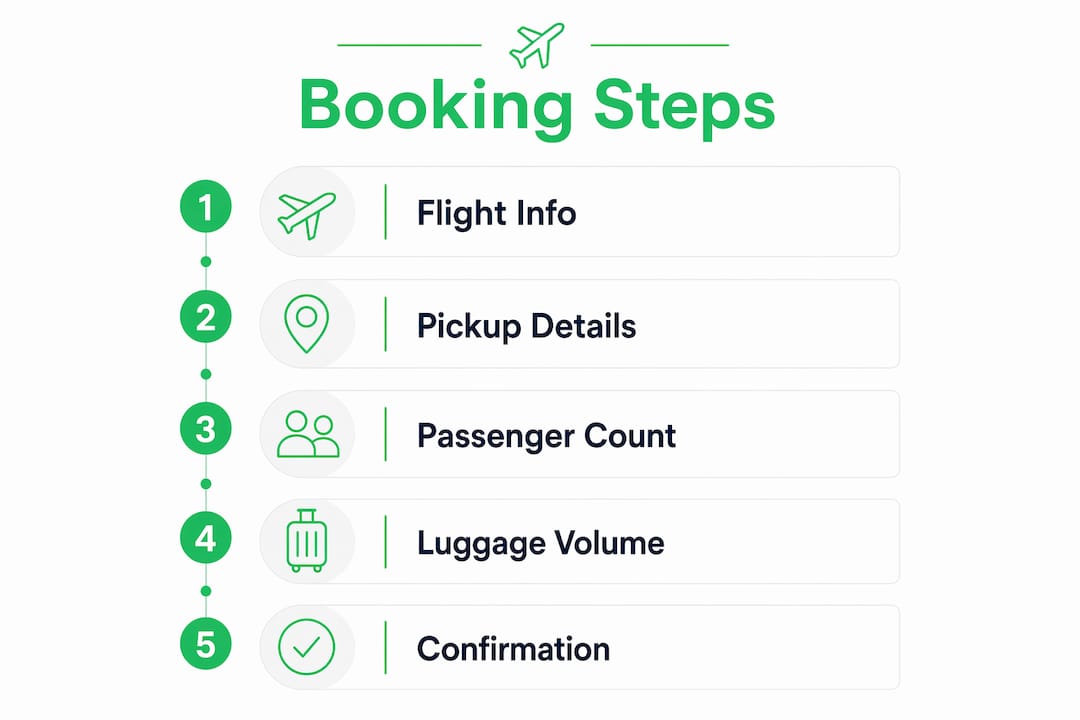
Six data points drive every successful airport transfer booking. Providing accurate information at the time of booking is what allows the service to function reliably from the moment your flight lands.
The six standard requirements are:
- Flight number: Used for real-time flight tracking and automatic pickup adjustments
- Pickup address: Your hotel, home, or meeting point for departures
- Drop-off address: The airport terminal or final destination for arrivals
- Date and time: Your scheduled departure or expected arrival time
- Passenger count: Determines vehicle size and capacity
- Luggage details: Number and size of bags to confirm vehicle fit
Six essential data points including flight number, addresses, date, passenger count, luggage volume, and contact info are required for a smooth booking. The flight number is the most critical of these. It is the link between your booking and the live airline data feed that keeps your driver informed.
Luggage information is critical because standard vehicles typically accommodate one or two suitcases. If you are traveling with ski equipment, a stroller, or oversized bags, that must be declared at booking so the provider assigns the right vehicle class. Showing up with four bags when you declared two creates a problem that cannot be solved curbside.
Pro Tip: When booking for a group, list the total number of carry-on bags in addition to checked luggage. Overhead-style bags take up trunk space too, and providers like Zont use this detail to match you with the correct vehicle size from their fleet.
For travelers with accessibility requirements or medical equipment, reputable providers like Zont collect this during the booking data collection process so the right vehicle is dispatched from the start.
How far in advance should you book an airport transfer?
Timing your booking correctly is one of the most overlooked airport transfer booking tips, and getting it wrong costs you options, money, or both.
Follow this sequence for the best outcome:
- Book as soon as your flight is confirmed. Industry guides recommend booking the moment flight details are confirmed to lock in availability. This is especially true for early morning or late-night pickups when driver supply is limited.
- Book at least 24 to 48 hours in advance as a minimum. The standard minimum notice across the industry is 24 to 48 hours. Anything shorter risks no availability, particularly in smaller cities.
- Book one week or more ahead for peak travel periods. Summer school holidays, Christmas, and major events in cities like Milan, Berlin, or Monaco create demand spikes that exhaust vehicle availability days in advance.
- Book two or more weeks ahead for large groups or special vehicles. Executive minivans, wheelchair-accessible vehicles, and luxury cars are lower-inventory categories. Booking early secures preferred vehicle types and locks in better pricing before demand pushes rates up.
- Avoid last-minute bookings whenever possible. Last-minute requests risk higher costs, limited vehicle choice, and reduced driver availability. A guide to booking airport transportation early confirms that peak-period last-minute bookings frequently result in no availability at all.
Pro Tip: Set a calendar reminder for 24 hours before your travel day to reconfirm your booking details and verify your flight number has not changed. A flight number change due to an airline schedule adjustment can break the tracking link if your provider is not updated.
What types of airport transfer services are available?
The booking airport transfer process differs depending on which service tier you choose. Each type serves a different traveler profile, and selecting the wrong one is a common and avoidable mistake.
| Service type | Best for | Pricing model | Key feature |
|---|---|---|---|
| Private transfer | Individuals, couples, families | Fixed per trip | Door-to-door, no shared stops |
| Shared shuttle | Solo budget travelers | Fixed per seat | Multiple pickup/drop-off points |
| Executive car | Business travelers | Fixed, premium rate | Luxury vehicle, professional driver |
| Meet and greet | First-time visitors, VIPs | Add-on or included | Driver waits in arrivals hall with name board |
Private transfers are the most popular choice for families and business travelers because the vehicle goes directly from point A to point B with no detours. Shared shuttles cost less per person but add 20 to 45 minutes of travel time due to multiple stops, which matters when you have a connection to make.
Meet and greet services place the driver inside the arrivals hall holding a name board, which eliminates the stress of locating your ride after a long flight. For anyone arriving in an unfamiliar city or traveling with children, this service level is worth the marginal extra cost.
Executive cars, typically Mercedes-Benz E-Class or S-Class vehicles, BMW 5 Series, or equivalent models, are confirmed at booking along with the driver's credentials. Professional drivers are licensed, insured, and vetted, and many are English-speaking, which reduces communication friction for international travelers arriving in non-English-speaking countries.
Pro Tip: Always match your vehicle class to your actual luggage load, not your passenger count. Four passengers with four large suitcases need a minivan, not a standard sedan, even if the sedan technically seats four.
How does flight tracking work in airport transfers?
Flight tracking is the technology layer that separates professional airport transfer services from standard taxis, and it works entirely in the background without any action required from you.
Here is what happens from the moment you submit your flight number:
- The provider's system links your booking to a live airline data feed using your flight number as the identifier
- Flight tracking technology monitors aircraft status in real time, including gate changes, delays, and early arrivals
- When your flight status changes, the system automatically recalculates the driver's dispatch time
- The driver arrives at the correct time based on actual landing, not scheduled landing
- You receive no stress, no phone calls, and no coordination tasks
This flight tracking integration is what makes professional transfers reliably on time in a way that taxis and rideshares cannot replicate. A taxi driver waiting at arrivals for a flight delayed by 90 minutes either leaves or charges you for waiting. A transfer driver dispatched by a tracking system simply arrives when your plane does.
Zont uses this technology across its network of 120+ European cities, which means a delayed flight into Milan Malpensa, Berlin Brandenburg, or Nice Côte d'Azur does not result in a missed pickup. The system handles the adjustment automatically.
Practical steps for booking your airport transfer
The booking airport transfer process takes under five minutes when you have your travel details ready. Follow these steps exactly.
- Gather your travel details. Have your confirmed flight number, full pickup and drop-off addresses, travel date, passenger count, and luggage count ready before opening any booking platform.
- Choose your service type. Decide between private, shared, or executive based on group size, budget, and comfort preference. If you are unsure, private is the default choice for reliability.
- Enter your details and get a price quote. Use a trusted provider's website or app. Platforms like Zont's booking platform display fixed prices instantly with no hidden fees added at checkout.
- Confirm your booking and review every detail. Check the pickup address, flight number, and passenger count before paying. Errors here are the most common cause of coordination problems on travel day.
- Keep communication lines open. Save your driver's contact number from the confirmation email. On travel day, keep your phone accessible and charged so the driver can reach you if needed.
Pro Tip: Check your booking confirmation for the driver's name and vehicle details the evening before your trip. Knowing what to look for in arrivals means you spend 30 seconds locating your driver instead of five anxious minutes scanning the crowd.
For travelers covering multiple European destinations, Zont's European transfer destinations page lets you check coverage and book across cities in a single account.
Key takeaways
Airport transfer booking works by linking your confirmed flight data to a pre-dispatched driver, a fixed price, and real-time tracking that adjusts automatically to your actual arrival time.
| Point | Details |
|---|---|
| Provide accurate flight data | Your flight number drives tracking, timing, and driver dispatch. Never omit it. |
| Book as early as possible | Booking at flight confirmation secures vehicle choice and locks in fixed pricing. |
| Match vehicle to luggage | Declare all bags at booking to avoid vehicle mismatches on travel day. |
| Use meet and greet for unfamiliar airports | Driver in arrivals hall eliminates location stress after long or delayed flights. |
| Flight tracking removes coordination burden | The system adjusts driver timing automatically. You do not need to call anyone. |
Why I think most travelers underestimate the booking step
I have covered ground transportation across dozens of European cities, and the single most consistent mistake I see travelers make is treating the booking form as a formality. They enter approximate addresses, skip the luggage field, and type in the scheduled arrival time instead of the flight number. Then they wonder why the driver is not there when they land 40 minutes late.
The booking form is not a formality. It is the operational brief your driver works from. Every field you fill in accurately is one fewer problem on travel day. The flight number field in particular is non-negotiable. Without it, the tracking system has nothing to monitor, and your driver is working from a scheduled time that the airline may have already changed.
I also see travelers skip the meet and greet option to save a few euros, then spend 20 minutes wandering arrivals looking for a driver standing outside near a car park. At a large airport like Milan Malpensa or Berlin Brandenburg, that is a genuinely stressful experience. The meet and greet upgrade at most providers costs less than a coffee at the airport. It is almost always worth it.
One more observation: vehicle class matters more than most people realize. I have seen families of four with a combined eight bags try to fit into a standard sedan because they booked based on passenger count alone. The driver cannot legally carry luggage that does not fit safely. Always declare your bags.
— Arthur
Book your next airport transfer with Zont
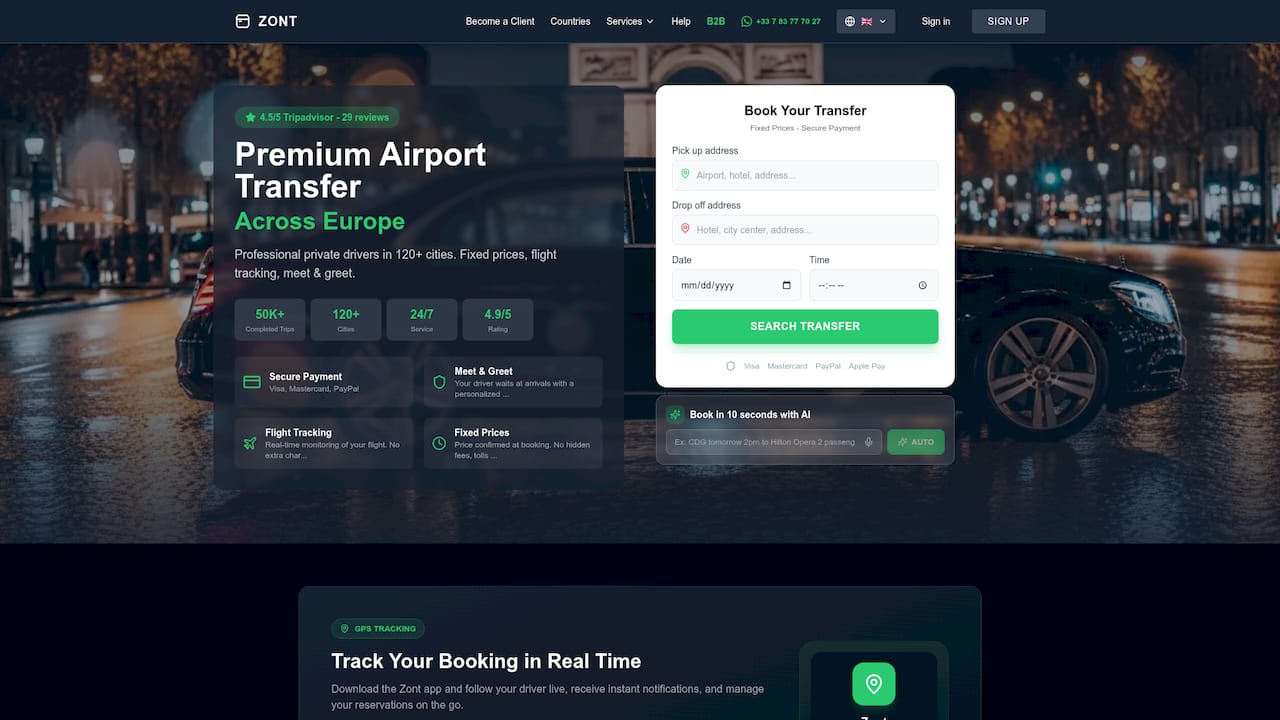
Zont operates premium airport transfers across 120+ cities in Europe, covering major hubs including Milan, Berlin, Nice, Alicante, and Monaco. Every booking includes fixed pricing with no hidden fees, real-time flight tracking, and a professional licensed driver confirmed before you travel. The booking process takes under five minutes on Zont's website, and 24/7 support is available if your plans change. With over 50,000 completed trips and a 4.5-star rating on TripAdvisor, Zont delivers the punctuality and professionalism that international travelers depend on. Book your transfer and arrive with confidence.
FAQ
What is an airport transfer booking?
An airport transfer booking is a pre-arranged, fixed-price transportation reservation that connects your flight details to a confirmed driver and vehicle. Unlike taxis, the price is agreed before travel and does not change based on traffic or delays.
How far in advance should I book an airport transfer?
The industry standard minimum is 24 to 48 hours, but booking as soon as your flight is confirmed is the best practice. For peak travel periods or large groups, booking one to two weeks ahead secures vehicle availability and better pricing.
What happens if my flight is delayed?
Professional transfer providers use real-time flight tracking linked to your flight number to monitor delays automatically. The driver's dispatch time adjusts to your actual landing time, so you do not need to call or update anyone.
What information do I need to book an airport transfer?
You need your flight number, pickup and drop-off addresses, travel date and time, passenger count, and luggage details. The flight number is the most critical field because it powers the tracking system that keeps your driver on schedule.
What is the difference between a private transfer and a shared shuttle?
A private transfer takes you directly from point A to point B with no other passengers. A shared shuttle costs less per person but makes multiple stops, adding 20 to 45 minutes to your journey time depending on the route.