
A corporate airport transfer program is a structured, managed service that arranges professional ground transportation for business travelers, coordinating logistics, safety compliance, and expense reporting under a single operational framework. Unlike booking a ride-share app at the curb, these programs integrate with tools like SAP Concur, align with ISO 31030:2021 travel risk standards, and connect to curated supplier networks such as Groundspan to give travel managers full visibility and control. The result is a system that treats ground transportation as a governed business function, not an afterthought. For any organization moving executives, client delegations, or employee groups through airports regularly, a formal program is the difference between controlled spend and chaotic reimbursement.
What is a corporate airport transfer program?
A corporate airport transfer program is the formal industry term for what many organizations call "managed ground transportation." It covers the full cycle of arranging, monitoring, and reconciling professional vehicle services between airports and business destinations, whether that is a hotel, headquarters, conference venue, or private residence. The program replaces ad hoc bookings with a governed process that addresses four simultaneous business needs: logistics coordination, traveler safety, cost control, and expense transparency.
The logistics layer handles scheduling, vehicle assignment, and driver communication. The safety layer connects to travel risk management frameworks and real-time flight tracking. The cost layer negotiates fixed pricing and volume discounts through supplier contracts. The expense layer feeds structured receipt data directly into finance systems. When all four layers work together, travel managers stop firefighting individual bookings and start managing a program with measurable outcomes.

Organizations like Fortune 500 companies use these programs to move hundreds of travelers per month across multiple cities, often through a single master contract that covers every leg. The program scales from a single executive airport shuttle to coordinated group arrivals across a dozen European airports in the same week.
Key features and components of a corporate transfer program
The structural backbone of any corporate airport transfer program consists of five core components. Each one addresses a specific operational gap that unmanaged bookings leave open.
-
Centralized supplier network. Rather than letting travelers book from any provider, the program sources from a curated list of vetted operators. Platforms like Groundspan aggregate transportation suppliers and allow volume pricing negotiation, replacing multiple vendor contracts with a single agreement. Fortune 100 and Fortune 500 clients use this model to consolidate spend and enforce quality standards simultaneously.
-
Real-time flight monitoring. Flight delay monitoring allows transfer providers to adjust pickup times and vehicle assignments proactively when schedules shift. A traveler whose flight lands 90 minutes late does not need to call anyone. The driver already knows.
-
24/7 traveler support. Duty of care requires that travelers can reach a human at any hour. Programs build this into service-level agreements with providers, not as a courtesy but as a contractual obligation.
-
Governance and policy documentation. Written policies define which traveler grades qualify for which vehicle class, what advance booking windows apply, and how exceptions are approved. This documentation is the evidence layer that satisfies legal frameworks like OSHA's General Duty Clause.
-
Expense and ERP integration. Structured e-receipts from completed transfers auto-populate into systems like SAP Concur Travel and Expense, eliminating manual data entry and creating clean audit trails.
Pro Tip: Before selecting a transfer provider, ask specifically whether their e-receipts include structured data fields such as trip date, route, duration, and cost. Generic PDF receipts do not integrate with ERP workflows. Structured data does.
How do corporate transfers support travel risk management and duty of care?
Duty of care extends beyond hotel selection and flight booking. Ground transportation is one of the highest-risk segments of any business trip, and a formal transfer program is the primary mechanism for controlling that risk. The ISO 31030:2021 standard, published by the International Organization for Standardization, defines a four-pillar model for corporate travel risk management that maps directly onto transfer program design.
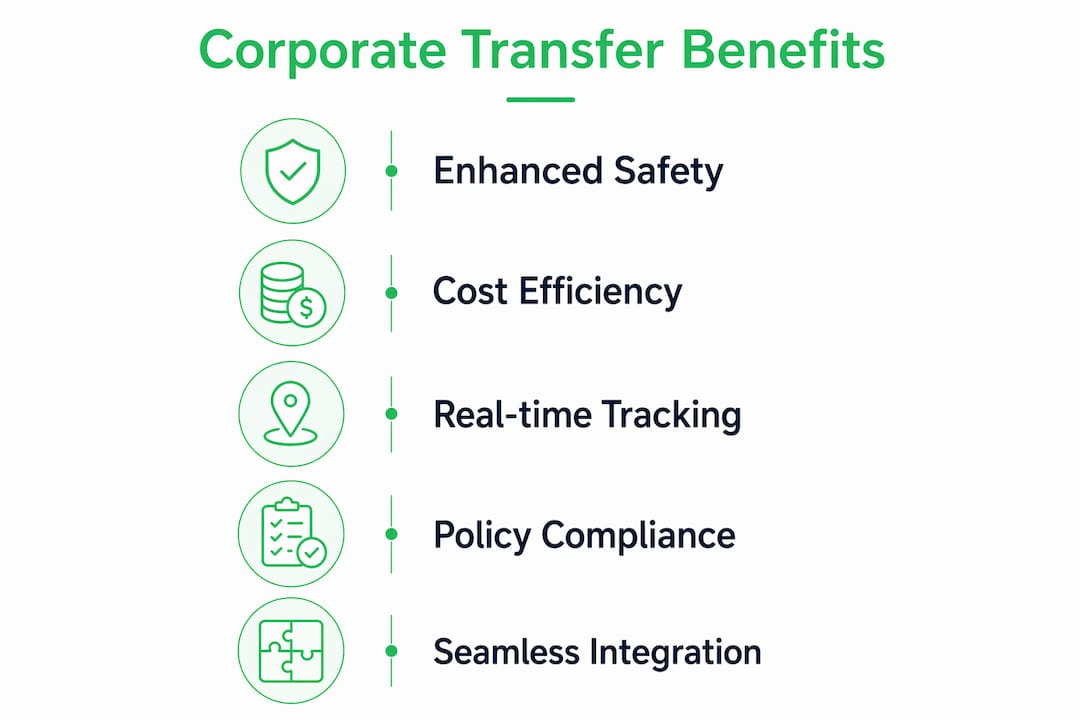
| ISO 31030 Pillar | Application to airport transfers |
|---|---|
| Governance | Written transfer policies, approved supplier lists, vehicle class rules |
| Pre-trip risk assessment | Route risk scoring, driver background verification, vehicle safety checks |
| Real-time monitoring | Flight tracking, GPS vehicle location, traveler check-in protocols |
| Post-incident review | Trip-level incident logs, driver performance reports, policy updates |
The legal dimension matters as much as the operational one. OSHA's General Duty Clause requires employers to provide a workplace free from recognized hazards, and courts have interpreted this to include transportation arranged by the employer. A documented transfer program with vetted drivers and tracked vehicles is defensible evidence of compliance. An expense report showing a ride-share charge is not.
"Travel risk management is no longer a travel department concern. It is a board-level KPI." According to a GBTA 2025 BTI Outlook survey, 71% of travel managers now enforce formal travel risk management frameworks across their programs.
That statistic reflects a real shift in how organizations treat ground transportation. The risk is not hypothetical. Executives traveling through unfamiliar cities, late-night arrivals in high-crime areas, and multi-stop client itineraries all carry exposure that a vetted, monitored transfer program actively reduces.
How to integrate transfer bookings with expense and ERP systems
Integration is where corporate airport transfer programs generate their most measurable return on investment. Without it, every completed trip creates manual work: the traveler submits a receipt, a finance team member codes it, an auditor checks it, and a manager approves it. With it, the process is largely automatic.
Here is how a well-integrated program operates end to end:
-
Booking. The travel manager or traveler books through a platform connected to the corporate travel management system. Gem Worldwide, for example, integrates with Concur Travel and Expense, so the booking appears in the traveler's itinerary automatically.
-
Trip completion. The driver closes the trip in the provider's system. The platform generates a structured e-receipt containing trip date, route, duration, and cost in pre-categorized fields.
-
Auto-population. The e-receipt auto-matches to the travel itinerary within 24 hours. The expense line appears in the traveler's report without any manual input.
-
Audit trail creation. Finance teams see a clean, categorized record with no ambiguity about what was purchased, where, or by whom.
-
Spend analysis. Monthly reporting aggregates trip-level data across the entire program, giving travel managers the visibility to renegotiate supplier contracts and identify policy exceptions.
The pitfall that undermines this entire chain is selecting a provider whose receipts are PDF attachments rather than structured data. A PDF requires human interpretation. Structured data flows directly into ERP fields. Travel managers evaluating providers should treat structured e-receipt capability as a non-negotiable requirement, not a nice-to-have feature.
Pro Tip: Request a sample e-receipt from any transfer provider before signing a contract. If it is a PDF with no data fields, the integration promise is marketing, not reality.
Comparing corporate transfer service models and procurement strategies
Travel managers choosing between service models face a genuine trade-off between control, cost, and operational complexity. The three primary models each serve different organizational profiles.
Centralized platform sourcing uses a single technology layer, such as Groundspan, to aggregate multiple suppliers under one contract. The platform negotiates volume discounts across vendors, enforces quality standards, and provides consolidated monthly reporting. This model suits large organizations with high trip volumes across multiple cities or countries. The trade-off is that the platform adds a layer between the buyer and the supplier, which can slow issue resolution.
Curated network sourcing involves the travel manager selecting a small number of preferred providers in each market, negotiating directly, and managing those relationships in-house. This gives more control over service standards and pricing terms but requires significant procurement bandwidth. It works well for organizations with a dedicated ground transportation manager and a stable set of travel corridors.
Direct vendor relationships mean booking with a single provider per city, often a local executive airport shuttle or chauffeur company. This is the simplest model but the least scalable. Pricing is rarely optimized, reporting is fragmented, and duty of care documentation varies by vendor.
- Centralized platforms deliver the best cost-per-trip outcomes at scale, but require upfront integration work.
- Curated networks offer the best service consistency when managed actively.
- Direct vendor relationships are appropriate only for low-volume programs or markets where no platform coverage exists.
For group travel and client transportation specifically, the centralized or curated model is the only defensible choice. Coordinating 20 executives arriving on different flights into the same conference requires a system, not a phone call to a local car service.
Key takeaways
A corporate airport transfer program delivers measurable value only when governance, technology integration, and supplier quality operate together as a unified system.
| Point | Details |
|---|---|
| Define the program formally | Written policies, approved suppliers, and vehicle class rules are the foundation of a defensible program. |
| Prioritize ISO 31030 alignment | The four-pillar framework covers governance, pre-trip assessment, real-time monitoring, and post-incident review. |
| Require structured e-receipts | Structured data fields auto-populate ERP systems; PDF receipts create manual work and audit gaps. |
| Use centralized sourcing at scale | Platforms like Groundspan consolidate vendors, negotiate volume pricing, and deliver monthly spend reporting. |
| Treat flight tracking as standard | Real-time flight monitoring is a baseline feature, not a premium add-on, for any program serving executives. |
Why governance is the part most programs get wrong
Travel managers often build corporate airport transfer programs from the outside in. They find a reliable provider, negotiate a rate, and call it a program. What they have is actually a preferred vendor relationship, which is a useful starting point but not a program. The difference shows up the moment something goes wrong.
I have seen organizations with excellent supplier relationships completely unable to demonstrate duty of care during an incident review because they had no written policy, no documented risk assessment, and no trip-level tracking data. The provider was fine. The program did not exist on paper.
The ISO 31030 framework is not bureaucratic overhead. It is the structure that turns a vendor relationship into a defensible, auditable program. The ground transportation role in business travel is increasingly scrutinized at the board level, and travel managers who treat it as a logistics detail rather than a risk function are one incident away from a very uncomfortable conversation with legal.
The integration question is equally underestimated. Manual reconciliation does not just waste time. It introduces errors, delays reimbursements, and obscures spend patterns that would otherwise trigger renegotiation. The value of a ground transportation partner is only fully realized when the booking, tracking, and expense layers are connected. Build the governance first, then the technology, then the supplier network. Most programs do it in the opposite order and spend years patching the gaps.
— Arthur
Zont's corporate airport transfer services across Europe
Zont delivers premium airport transfers across Europe in 120+ cities, purpose-built for corporate travel programs that require reliability, transparency, and professional execution at every touchpoint.
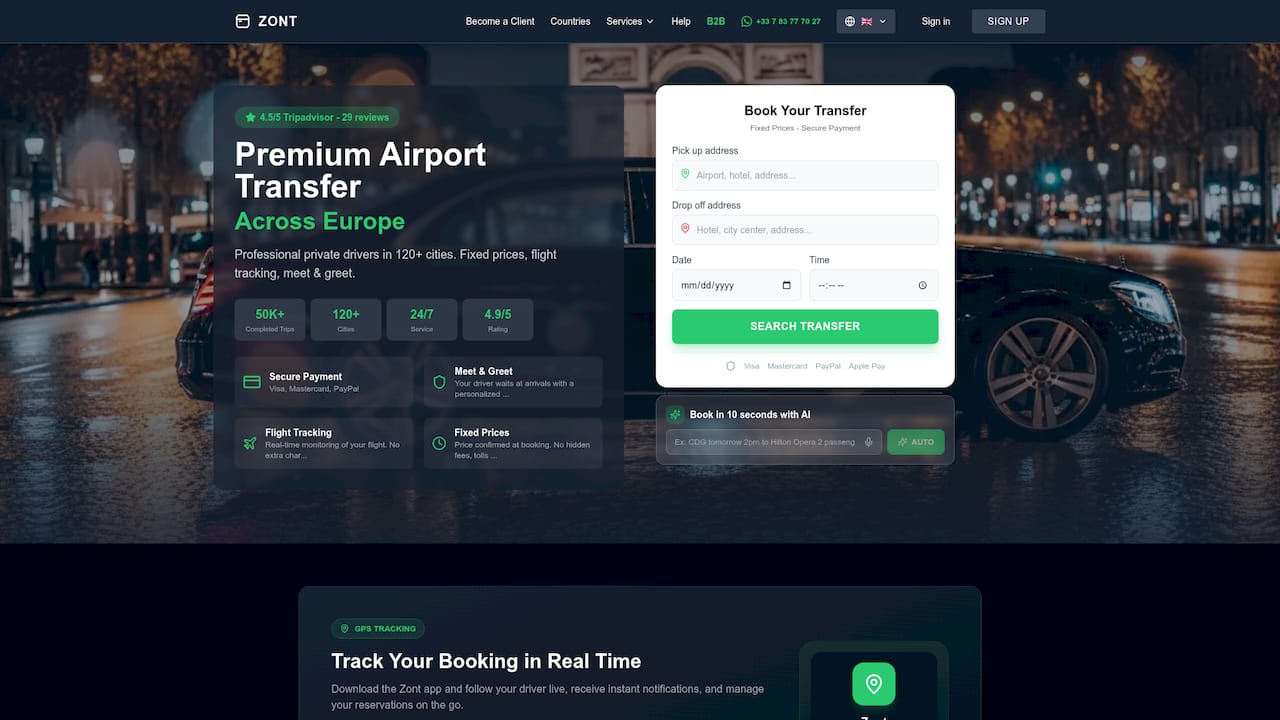
Every Zont booking includes real-time flight tracking, meet and greet service, and fixed pricing with no hidden fees. For travel managers, that means no surprise charges on expense reports and no manual reconciliation headaches. For executives, it means a professional driver waiting at arrivals regardless of delays. Zont's corporate client services support group travel coordination, client transportation, and recurring executive transfers with the consistency that ad hoc bookings cannot deliver. With over 50,000 completed trips and a 4.5-star rating on TripAdvisor, the track record speaks directly to the punctuality and professionalism that corporate programs demand.
FAQ
What is a corporate airport transfer program?
A corporate airport transfer program is a managed service that arranges professional ground transportation for business travelers between airports and destinations, governed by written policies, vetted suppliers, and expense system integrations. It differs from ad hoc bookings by treating ground transportation as a formal, auditable business function.
How does a corporate transfer program support duty of care?
Corporate transfer programs fulfill duty of care obligations by using vetted drivers, real-time flight monitoring, and documented risk policies aligned with ISO 31030:2021 standards. The 71% of travel managers who now enforce formal travel risk frameworks treat ground transportation as a core component of that compliance.
What systems do corporate airport transfer programs integrate with?
The most common integrations are with SAP Concur Travel and Expense, where structured e-receipts from completed transfers auto-populate expense reports and itineraries within 24 hours. ERP systems and travel management platforms also receive trip-level data for auditing and spend analysis.
How do curated supplier networks reduce costs?
Curated supplier networks like Groundspan consolidate multiple vendors under a single contract, enabling volume pricing negotiations that individual direct bookings cannot achieve. The result is lower cost-per-trip and simplified contract management compared to maintaining separate agreements with providers in each city.
What is the difference between an executive airport shuttle and a corporate transfer program?
An executive airport shuttle is a single service offering, typically a vehicle and driver for one trip. A corporate airport transfer program is the broader operational framework that governs how those services are sourced, booked, tracked, and reconciled across an entire organization's travel activity.