
Comparing airport transfer providers means evaluating pricing models, service reliability, vehicle types, and included features to find the best fit for your specific trip. The choice between a shared shuttle, private car, taxi, or public bus is not just about cost. It determines whether you arrive on time, stress-free, and within budget. With private transfer costs ranging from $70 to $150 and shared shuttles running $20 to $40 per person at major hubs like London Heathrow and Paris CDG, the price gap is real and the trade-offs are worth understanding before you book.
What are the main types of airport transfer services?
Airport ground transportation falls into four distinct categories, each suited to a different traveler profile. Understanding the differences before you book saves money and prevents frustration at the arrivals hall.
Shared shuttle services pick up multiple passengers traveling in the same general direction and drop each one at their destination. Shared shuttle costs at London Heathrow run $25 to $40 per person, while Paris CDG averages $20 to $35. That pricing makes shuttles the most affordable option for solo travelers and couples, but the trade-off is time. You may wait 20 to 40 minutes for other passengers to board and endure multiple stops before reaching your hotel.

Private transfers assign a dedicated vehicle and driver to your party from pickup to drop-off. Costs typically range from $70 to $150 for city-center routes at major international airports. For groups of three or more, the math shifts: a private transfer for groups at JFK runs roughly $100 total, while three shared shuttle tickets cost $105. Privacy, direct routing, and luggage flexibility make private transfers the preferred choice for families, business travelers, and anyone with tight connections.
Taxis and rideshare apps offer on-demand convenience but carry the highest price variability, with fares ranging from $55 to $120 depending on demand and traffic. They work well for solo travelers during off-peak hours who are comfortable with price uncertainty.
Public transportation (rail, metro, or bus) is the cheapest option in cities like London, Paris, and Amsterdam, but it requires navigating unfamiliar systems with luggage, which adds stress after a long flight.
| Service type | Typical cost | Best for | Key trade-off |
|---|---|---|---|
| Shared shuttle | $20–$40/person | Solo travelers, budget trips | Multiple stops, longer journey |
| Private transfer | $70–$150 total | Groups, families, business | Higher upfront cost |
| Taxi/rideshare | $55–$120 | Solo, off-peak flexibility | Surge pricing risk |
| Public transport | $5–$20 | Budget travelers, light luggage | Navigation complexity |
Pro Tip: If you are traveling with two checked bags and a carry-on, confirm luggage capacity before booking any shared shuttle. Many services limit bags per passenger and charge overage fees at the curb.
How to evaluate pricing models and avoid unexpected costs
Fixed fare pricing locks in your cost at the time of booking regardless of traffic, weather, or demand. Fixed fares eliminate surge risk entirely, which matters most during peak travel periods like holiday weekends or major events when rideshare multipliers can double or triple the base price. For families, corporate travelers, and anyone who needs a receipt for reimbursement, fixed pricing is the only rational choice.
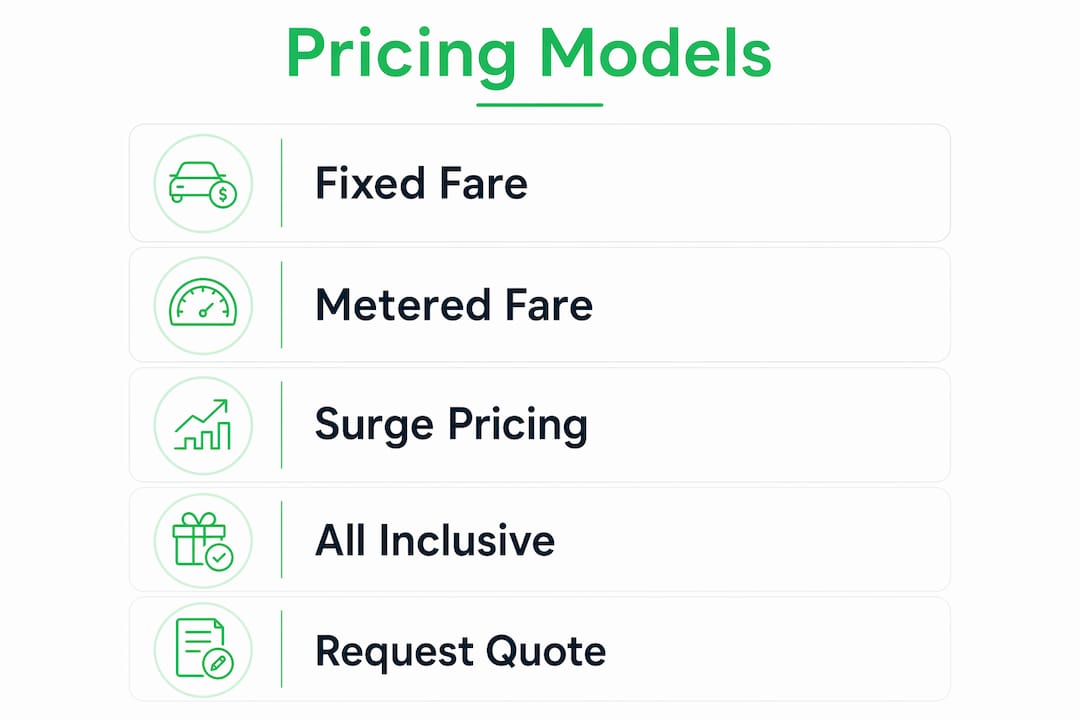
Surge pricing from rideshare apps operates on real-time demand algorithms. A ride that costs $45 at 2 p.m. on a Tuesday can jump to $110 at 6 p.m. on a Friday. Fixed fares benefit business travelers and families most, while surge pricing may occasionally favor solo travelers booking during low-demand windows. The problem is that airport arrivals rarely align with low-demand windows.
Beyond the base fare, hidden cost components catch travelers off guard. Confirm each of these before finalizing any booking:
- Waiting time fees: Some providers start the clock from scheduled arrival rather than actual landing. Waiting time policies should specify whether the timer starts from wheels-down or scheduled arrival time. The difference can add $15 to $30 to your bill.
- Toll and parking charges: Many providers quote a base fare that excludes airport parking fees or highway tolls.
- After-hours surcharges: Early morning or late-night pickups often carry a 15 to 25 percent premium.
- Luggage surcharges: Oversized bags, ski equipment, or strollers may trigger additional fees.
| Pricing model | Cost predictability | Surge risk | Best scenario |
|---|---|---|---|
| Fixed fare | High | None | Groups, business, families |
| Metered fare | Medium | Low | Short urban trips |
| Dynamic/surge pricing | Low | High | Off-peak solo travel |
Pro Tip: Always request a fully itemized quote in writing. If a provider cannot confirm the final price including tolls, parking, and waiting time before you book, treat that as a red flag.
What operational factors should influence your choice?
Reliability separates a good airport transfer from a stressful one. The most important operational feature is flight tracking. Effective operators track flights by flight number and adjust pickup times automatically when delays or terminal changes occur. A provider that simply says "we monitor flights" without specifying how is offering a vague promise, not a real service guarantee.
Airport transfers differ from typical rides because flight delays, terminal reassignments, and baggage claim wait times create variability that standard rideshare logistics cannot handle. A driver who arrives at the scheduled time but leaves after 10 minutes of waiting is not an airport transfer specialist. He is a taxi driver with a nicer car.
Meet and greet services add a meaningful layer of convenience. Premium door-to-door services include English-speaking drivers, luggage handling, and coordinated terminal assistance. This matters most at large, complex airports like Frankfurt, Charles de Gaulle, or Heathrow Terminal 5, where navigating from baggage claim to the correct exit can take 20 minutes without guidance.
Before booking any provider, get clear answers to these questions:
- Does the driver track your specific flight number, or just the scheduled time?
- What is the exact waiting time policy, and when does the clock start?
- Is the vehicle confirmed for your passenger count and luggage volume?
- What is the cancellation policy, and how quickly are refunds processed?
- Is there a direct phone number for the local driver or dispatcher on the day of travel?
- How does the provider respond to negative reviews online?
Reliable providers respond to negative reviews with constructive dialogue. Patterns of no-shows, unreachable support, or unresolved refund disputes are the clearest warning signs available before you hand over your credit card.
Pro Tip: Search the provider's name alongside "no show" or "refund" on Google and TripAdvisor before booking. One or two complaints are normal. A pattern of them is a dealbreaker.
How to compare airport transfer providers step by step
A structured approach to airport pickup comparisons prevents the most common booking mistakes. Follow these six steps before confirming any reservation.
- Define your priorities. Identify your group size, luggage count, budget ceiling, and whether you need a fixed arrival time. A solo traveler with one bag and a flexible schedule has different needs than a family of four with car seats and checked luggage.
- Research providers covering your specific airport and destination. Not every company serves every terminal or city zone. Confirm coverage before spending time on price comparisons.
- Compare total cost, not headline price. Request itemized quotes that include tolls, waiting time, and any surcharges. Use the pricing model table above to assess predictability.
- Verify licensing and insurance. Licensed operators carry commercial vehicle insurance and are registered with local transport authorities. Ask directly or check the provider's website for regulatory credentials.
- Check reviews on TripAdvisor, Google, and Trustpilot. Focus on recency and volume. A 4.8-star rating from 12 reviews is less reliable than a 4.3-star rating from 400 reviews.
- Confirm booking details in writing. Your confirmation should state the pickup location, driver contact, vehicle type, waiting time policy, and cancellation terms.
Booking through a marketplace offers side-by-side price comparisons, while booking directly with a local operator gives you clearer accountability and faster support on the day of travel.
| Booking method | Advantage | Disadvantage |
|---|---|---|
| Marketplace platform | Easy comparison, multiple options | Less direct accountability |
| Direct operator booking | Faster local support, clearer terms | Requires individual research |
For travelers booking private shuttle services for the first time, direct operator booking is generally the safer starting point because you can verify credentials and speak to someone before committing.
Key takeaways
Choosing the right airport transfer requires comparing pricing models, service types, and operational reliability before booking, not after arriving at the terminal.
| Point | Details |
|---|---|
| Match service type to group size | Shared shuttles suit solo travelers; private transfers become cost-effective for groups of three or more. |
| Always choose fixed pricing | Fixed fares eliminate surge risk and provide the cost predictability that families and business travelers need. |
| Demand real flight tracking | Providers must track your specific flight number and define waiting time policies clearly, not just claim they "monitor flights." |
| Verify total cost in writing | Confirm tolls, parking, after-hours fees, and luggage surcharges before booking to avoid surprises at pickup. |
| Review patterns, not just ratings | A pattern of no-shows or unresolved refunds in reviews outweighs a high average star rating. |
What I've learned from years of watching travelers get this wrong
Most travelers spend 45 minutes comparing flight prices and four minutes comparing ground transportation. That ratio is backwards. A missed transfer or a $200 surge-priced rideshare does more damage to a trip than a $30 fare difference on a flight.
The single most common mistake I see is choosing the cheapest option without reading the waiting time policy. A provider that starts the clock at scheduled arrival rather than actual landing will charge you for every minute your flight runs late. On a route like JFK to Manhattan, that can add $40 to a fare that looked like a bargain at booking.
The second mistake is trusting vague flight tracking claims. I have spoken with travelers who booked services that advertised "real-time flight monitoring" and still found no driver at arrivals because the company was tracking the scheduled time, not the actual flight. Ask the provider to explain their exact process. If they cannot describe it in two sentences, they do not have one.
My honest recommendation: prioritize reliability over price for any trip where being late has real consequences. A missed connection, a hotel check-in cutoff, or a business meeting cannot be rescheduled because your driver did not account for a 40-minute delay. The $20 you saved on a shared shuttle is not worth that risk. Book direct, get everything in writing, and confirm the driver's contact number the night before travel.
— Arthur
Travel smarter across Europe with Zont
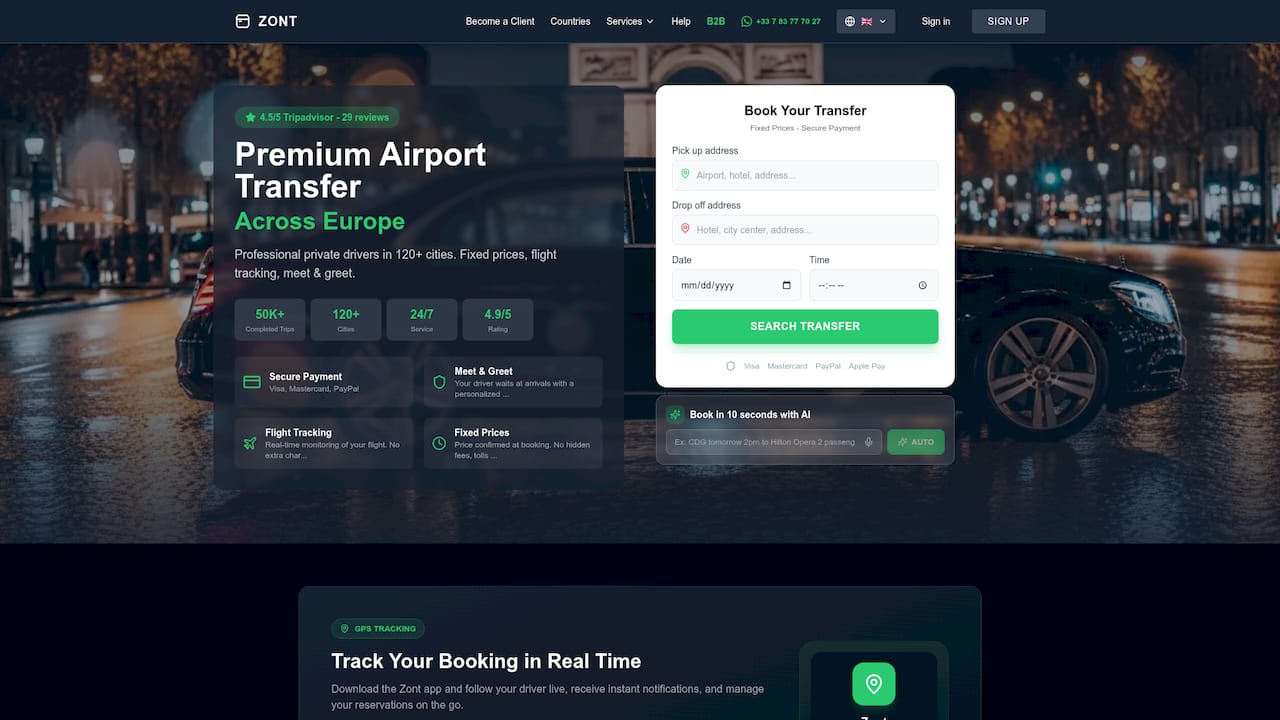
Zont operates premium airport transfers across 120+ cities in Europe, covering major hubs from Paris CDG and London Heathrow to Alicante and beyond. Every booking includes fixed pricing with no hidden fees, real flight tracking by flight number, and professional chauffeurs who meet you inside the terminal with a name board. Zont has completed over 50,000 trips and holds a 4.5-star rating on TripAdvisor, with travelers consistently citing punctuality and professionalism. Whether you need a Paris airport transfer with meet and assist or a private car for a corporate arrival, Zont delivers a confirmed, stress-free pickup every time. Book your next European transfer at zont.cab.
FAQ
What is the cheapest type of airport transfer?
Shared shuttle services are the most affordable option, with per-person costs ranging from $20 to $40 at major European airports. They are best suited for solo travelers or pairs who have flexible timing and light luggage.
When does a private transfer become more cost-effective than a shared shuttle?
Private transfers become more cost-effective for groups of three or more. At JFK, for example, three shared shuttle tickets cost more than a single private transfer booking for the same party.
What does fixed fare pricing mean for airport transfers?
Fixed fare pricing locks in the total cost at booking and does not change based on traffic, demand, or time of day. It eliminates the surge pricing risk that rideshare apps carry during peak travel periods.
How do I know if a provider actually tracks my flight?
Ask the provider to describe their exact flight tracking process. A reliable operator tracks your specific flight number, monitors delays and terminal changes, and has a defined waiting time policy that starts from actual landing rather than scheduled arrival.
Is it better to book through a marketplace or directly with an operator?
Marketplaces offer convenient side-by-side comparisons, but direct bookings with local operators provide faster support and clearer accountability on the day of travel. Whichever method you use, confirm you receive the local driver's contact information before your trip.